Source Door Seal Brush for Environmental Protection, Machinery, and Fire Prevention
Compare 30 door seal brush options from suppliers in Anqing and Zhejiang. Buyers can evaluate models like TOP-SB and BY-010, which feature nylon or steel wire materials for industrial, soundproof, and smoke prevention applications.
Key considerations
Products List




Comprehensive Sourcing Guide
Strategic Sourcing Guide for Industrial Door Seal Brushes
Procuring door seal brushes requires a nuanced understanding of the intersection between mechanical sealing performance and environmental compliance. The market for these components is diverse, ranging from simple nylon bristles for machinery to complex composite assemblies designed for fire and smoke prevention. Buyers must navigate a landscape where product attributes vary significantly between industrial cleaning brushes and perimeter sealing strips. This guide synthesizes available product data to establish a framework for evaluating suppliers, verifying technical specifications, and ensuring long-term supply chain reliability without relying on unverified market claims.
Technical Specifications and Material Composition
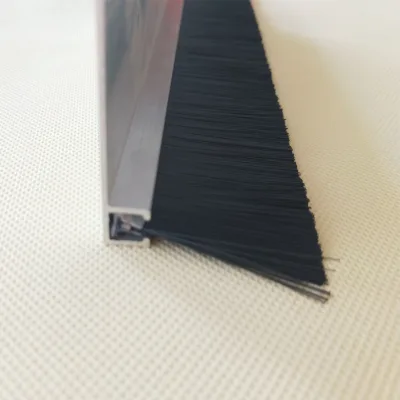
The foundation of a successful procurement strategy lies in the precise definition of technical requirements. The supplied product data reveals a distinct bifurcation in the market: products designed for general industrial brushing versus those engineered for environmental sealing. For industrial applications, the primary material observed is nylon wire, often categorized under an "Industrial" grade. These units are frequently associated with machinery and environmental protection applications, suggesting a use case focused on cleaning or debris removal rather than airtight sealing. In contrast, the sealing strip category presents a more complex material profile. Here, the bonding materials include aluminum, PVC, and composite materials, while the functional elements often involve high-density colored PTFE tapes or silicon rubber.
A critical distinction in the data is the variation in wire materials. While some entries list "Nylon," others specify "Steel Wire," indicating that the core bristle composition is not uniform across all listings. Buyers must verify the specific wire material required for their application, as steel wire offers different wear characteristics compared to nylon. Furthermore, the physical dimensions are highly variable. Observed standard lengths range from 600mm to 1300mm, with specific models citing 1000mm or 2" x 36" as standard configurations. The gap tolerance is equally critical; data indicates minimum and maximum gaps ranging from 3-13mm to 4-50mm, and even specific measurements like 1/2". Sourcing success depends on matching these exact tolerances to the door frame or machinery interface.
| Attribute Category | Industrial Brush Variant | Sealing Strip Variant |
|---|---|---|
| Primary Material | Nylon Wire, Steel Wire | Aluminum, PVC, Composite, Silicon Rubber |
| Standard Lengths | Variable (Model dependent) | 600-1300mm, 1000mm, 2" x 36" |
| Gap Tolerance | Not explicitly defined | 3-13mm, 4-50mm, 1/2" |
| Color Options | Not specified | Black, Grey, White, Brown, Customized |
| Installation | Machinery, Environmental | Bottom of doors, Perimeter, Frame |
Functional Applications and Installation Context
Understanding the intended function of the seal brush is paramount, as the data highlights specific use cases that dictate performance requirements. The observed applications are split between "Machinery" and "Environmental Protection." For machinery, the brush likely serves a cleaning or protective role, preventing debris ingress while allowing movement. For environmental applications, the function shifts dramatically to "Soundproof Smoke and Fire Prevention." This specific function requires a seal that can withstand thermal expansion and maintain integrity during a fire event.
Installation location is another critical differentiator. The data specifies three primary installation zones: "Install Around The Perimeter of Plain or Rebated," "Install on The Bottom of The Doors," and "Install on The Frame of Single or Double Doors." Each location presents unique challenges. Bottom-of-door installations often require flexibility to accommodate uneven floors, while perimeter installations on rebated frames demand precise compression to ensure a tight seal. The "Seal Tape Kind" also varies, with options like "Alu Holder+Brush" or "High Density Colored PTFE Tapes," suggesting that the mounting mechanism is as important as the sealing material itself. Buyers must confirm that the selected product is compatible with their specific door type, whether single or double, and the specific frame geometry.
Compliance, Certification, and Standard Verification
In the realm of fire and smoke prevention, compliance is not merely a suggestion but a legal and safety imperative. The supplied data mentions "Customized" standards and specific model numbers like "TOP-SB" and "BY-010," but it does not explicitly list third-party certifications such as UL, CE, or ISO. Buyers must treat the "Customized" standard attribute as a starting point for inquiry rather than a guarantee of compliance. When sourcing for fire prevention, the buyer must verify that the product meets local building codes and fire safety regulations.
The "Mildew Proof" attribute observed in the data is a specific performance claim that requires validation. In humid environments, a seal that is not mildew-proof can degrade rapidly, compromising the fire and smoke barrier. Buyers should request test reports or material safety data sheets (MSDS) that confirm the mildew resistance of the specific batch. Similarly, the "After-sales Service" attribute of "3 Years" suggests a supplier confidence in durability, but this should be verified against the warranty terms provided in the commercial contract. It is essential to distinguish between the product's inherent material properties and the supplier's service承诺. Without explicit mention of recognized industry standards in the provided facts, the buyer must proactively request documentation proving that the product meets the necessary fire rating and smoke containment standards for their jurisdiction.
Cost Drivers and Procurement Economics
The cost structure of door seal brushes is influenced by material composition, customization levels, and order volume. The observed price range of 0.01 to 8.8 USD indicates a wide disparity, likely driven by the complexity of the assembly. A simple nylon brush will naturally cost less than a composite unit featuring aluminum holders and PTFE tapes. The "Customization" attribute is a significant cost driver; products listed as "Customized" or with "Customized" standards often command a premium due to the tooling and setup required for non-standard dimensions or materials.
Minimum Order Quantity (MOQ) is another critical economic factor. The data shows an MOQ range from 1 to 10,000 units, with specific listings citing 300PCS or 500PCS. This variance suggests that suppliers operate on different scales. Small buyers may find suppliers with low MOQs, but they might face higher unit costs. Conversely, large volume orders can leverage economies of scale but require significant upfront capital. The "Project Solution Capability" attribute, which mentions a "Total Solution for Projects," implies that some suppliers offer bundled pricing or logistics support for large-scale installations, which can impact the total cost of ownership. Buyers should analyze the total cost, including shipping and potential customs duties, rather than focusing solely on the unit price.
Supplier Evaluation and Quality Assurance
Evaluating suppliers requires a focus on their ability to deliver consistent quality and adhere to the specific technical constraints of the project. The "After-sales Service" of 3 years is a positive indicator, but it must be backed by a clear service level agreement. Buyers should verify the supplier's capacity to handle "Project Solution Capability," ensuring they can manage complex installations involving multiple door types and sealing requirements. The origin locations "Anqing" and "Zhejiang" are noted in the data, providing geographical context for logistics planning. Buyers should consider the lead times associated with these regions and the reliability of the supply chain from these specific manufacturing hubs.
Quality control processes should be a central part of the supplier evaluation. Given the variation in materials like "Alu, Silicon Rubber" and "Composite Materials," the supplier must demonstrate robust quality control measures to ensure material consistency. The "New" condition of the products is a baseline requirement, but buyers should also inquire about batch testing procedures. For fire and smoke prevention products, random sampling and destructive testing may be necessary to verify that the "Soundproof Smoke Prevention" function is maintained over time. The "Mildew Proof" claim should be validated through accelerated aging tests or third-party laboratory results.
Long-Term Procurement Considerations
Sourcing door seal brushes is not a one-time transaction but a long-term partnership that impacts building safety and operational efficiency. The "Customized" nature of many products means that once a specific configuration is selected, switching suppliers can be difficult and costly. Buyers should ensure that the supplier has the capacity to maintain the specific "prod_model" (e.g., TOP-SB, BY-010) over the life of the project. The "prod_packing" variations, such as 30PC/Carton, 48PC/Carton, or 50PCS/CTN, also affect logistics and storage. Standardizing packaging across orders can reduce handling costs and minimize damage during transit.
Furthermore, the "State: Fluid" attribute observed in the data is unusual for a solid seal brush and may refer to a specific component or a data entry anomaly. Buyers must clarify this attribute to ensure they are ordering the correct physical form of the product. Long-term considerations also include the availability of replacement parts and the ability to source matching colors like "Black, Grey, White or Customized" for future repairs. A supplier that offers a "Total Solution for Projects" is better positioned to support these long-term needs, providing a single point of contact for maintenance and replenishment. By focusing on these strategic factors, buyers can secure a reliable supply of door seal brushes that meet both immediate technical requirements and long-term operational goals.
FAQs
What materials are used for door seal brushes?
Door seal brushes utilize materials such as nylon wire, steel wire, aluminum, PVC, and composite materials. Some variants also incorporate silicon rubber and high-density colored PTFE tapes for enhanced sealing performance in industrial and environmental applications.
Where can these seal brushes be installed?
These products are designed for installation around the perimeter of plain or rebated frames, on the bottom of doors, or on the frame of single or double doors. The specific location depends on the required gap tolerance and sealing function.
What is the minimum order quantity for these items?
The minimum order quantity ranges from 1 to 10,000 units, with specific listings showing MOQs of 300 or 500 pieces. Buyers should verify the exact MOQ with the supplier based on the chosen model and customization level.
Can the seal brushes be customized for specific needs?
Yes, customization is available for product models, standards, and dimensions. Suppliers offer options for customized wire materials, colors, and packing configurations to meet specific industrial or fire prevention requirements.
What functions do these sealing strips provide?
The primary functions include soundproofing, smoke prevention, and fire prevention by stopping the spread of fire or smoke across various fire zones. They also provide mildew-proof protection for long-term durability in humid environments.
What are the standard gap tolerances for these brushes?
Standard gap tolerances vary by model, ranging from 1/2 inch to 3-13mm and 4-50mm. Buyers must select a product that matches the specific gap size of their door frame or machinery interface.